Hardware vs Software Keyloggers — What's the Difference?
A hardware keylogger records keystrokes at the physical layer, invisible to the operating system. A software keylogger is a program the OS — and antivirus — can see. Here's how they compare.
Both a hardware and a software keylogger set out to do the same thing — record what is typed. Where they do it is what makes them completely different tools.
Where each one sits
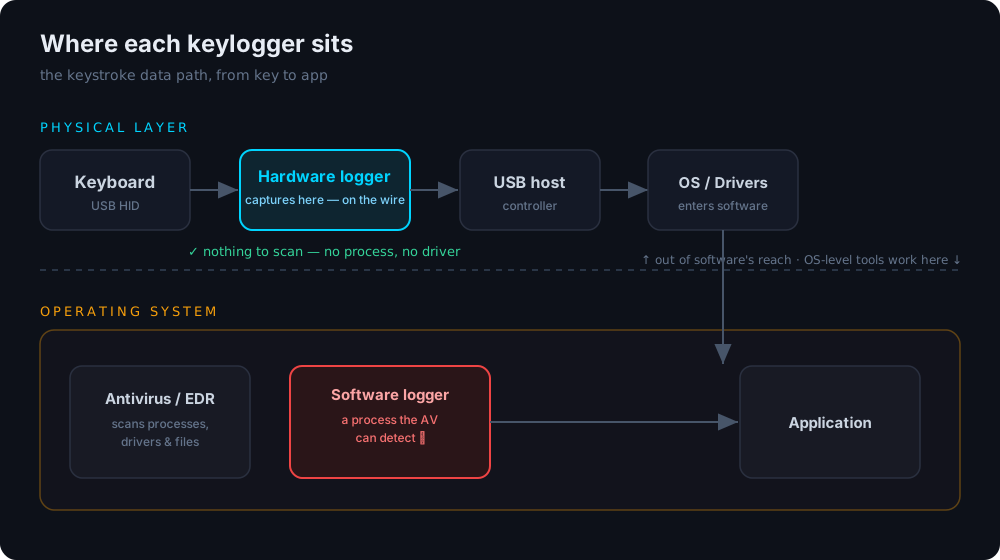
A hardware keylogger is a small pass-through device that plugs in between the keyboard and the computer. It reads keystrokes on the wire, before they reach the USB host controller — so capture happens at the physical layer, below the operating system entirely.
A software keylogger is a program installed on the target machine. It runs inside the operating system, alongside every other process, which is exactly where antivirus, EDR and endpoint tools do their scanning.
Detectability
This is the decisive difference.
- A hardware logger installs no software — no process, no driver, no file. Security scanners have nothing to find; to the OS it's just a keyboard.
- A software logger is a process on disk and in memory. Antivirus and anti-spyware are built to spot exactly that, and an OS update can break it or flag it.
Side by side
| Hardware keylogger | Software keylogger | |
|---|---|---|
| Installation | Plug in inline — seconds, no access needed | Requires OS access, usually admin rights |
| Visible to antivirus / EDR | No — nothing to scan | Yes — it's a process |
| OS dependence | Independent (Windows, macOS, Linux) | Tied to one operating system |
| Record & playback | Can be done on two different machines | Locked to the single machine |
| Capture at power-up | Yes — from the moment the keyboard powers | No logging before the OS boots |
| Licensing / updates | None | Per-install licence, must track OS updates |
When each makes sense
A software keylogger can be reasonable when you fully control the machine, need no stealth, and want features tied to the OS (screenshots, app-level context).
A hardware keylogger wins whenever you need it to just work: no install, no drivers, no surprises after an update, nothing for a scanner to catch, and the ability to capture pre-boot passwords. It's the cleaner, more reliable option for authorized monitoring and forensic work.
Bottom line
Software keyloggers live inside the operating system — convenient, but detectable and OS-bound. Hardware keyloggers work a layer below it, which makes them stealthy, OS-independent and effortless to deploy. If you want a recorder that stays invisible to software and needs zero installation, hardware is the answer. See how the AirDrive and KeyGrabber families compare.
Use responsibly. Hardware keyloggers are for authorized monitoring only — your own devices, employee monitoring with consent, or investigations with proper legal authority.